This article may contain affiliate links. If you buy through them, Living Beautifully Daily may earn a small commission at no extra cost to you. Learn more.
Breakfast is the meal most households skip setting entirely, plates and mugs placed wherever there is open counter space, silverware grabbed one piece at a time as it is needed. That works, in the sense that people get fed, but it also means more trips back to the drawer, more reaching across other people’s space, and more items that end up forgotten until the meal is half over. The logic behind a proper table setting was built to solve exactly this kind of friction, and it applies just as well to a bowl of oatmeal as it does to a formal dinner.
The plate anchors everything else
Start with the plate centered in front of the seat, about an inch from the table edge. Everything else gets placed relative to that plate, which is why it goes down first. For breakfast this might be a full dinner plate for eggs and toast, or a smaller bread plate if the meal is lighter, but the placement logic is the same either way.
Utensils go in the order you will use them
The standard rule is that utensils are placed in the order of use, working from the outside in toward the plate. For a simple breakfast this usually means very little cutlery, but the same logic still applies. A fork goes to the left of the plate. A knife goes to the right, blade facing the plate, and a spoon goes to the right of the knife, since spoon usually comes after knife work in the eating order, or first if the spoon is for cereal or oatmeal and there is nothing else to cut.
- Fork: left of the plate
- Knife: right of the plate, blade facing inward toward the plate
- Spoon: right of the knife
- Small spoon for coffee or a soft egg: placed on the saucer or just above the plate, not mixed into the main utensil row
If the meal only needs a fork, that is the only utensil that goes down. Setting out a knife nobody will touch just to look complete adds clutter and a piece to wash for nothing.
Where the cup and glass actually belong
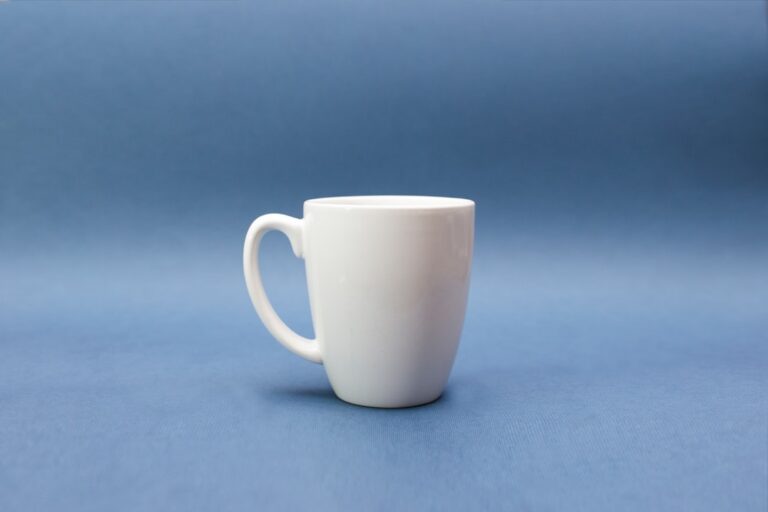
The beverage glass or cup goes above the knife, roughly at the tip of the knife blade, on the right side. This placement is not arbitrary. Most people reach for their drink with their right hand, and positioning it above the knife keeps that reach short and keeps it out of the path of the fork hand on the left. A coffee cup with a saucer follows the same logic, placed above and slightly right of the plate, handle turned to the right so it is ready to pick up without rotating the cup first.
This detail, handle turned to the right, sounds fussy until you notice how often an unset cup ends up with its handle facing away from the dominant hand, forcing a small rotation every single time someone reaches for it. Over a week of breakfasts that is a lot of unnecessary handling.
Napkin placement depends on what is on the plate
A folded napkin goes to the left of the fork, or underneath it, for a typical setting. If the meal involves food that will be eaten with hands, toast, a pastry, fruit, the napkin can go directly on the plate or folded beside it where it is easiest to grab quickly, since it will be used often and early in the meal rather than at the end.
A table set with intention is not about formality. It is about making sure every hand reaches for something and finds it exactly where it expects it to be.
Setting for a family table with mixed needs
A shared breakfast table often has different needs at each seat, a child’s seat with just a spoon and a cup with no saucer, an adult seat with coffee and toast. The core logic still holds at each individual seat even when the overall table looks mismatched. What matters is that each person’s utensils and cup are placed correctly relative to their own plate, not that every seat is identical to the next. Consistency across the table matters less than consistency within each place setting.
Shared items go where they are reachable by everyone
Butter, jam, a pitcher of milk, these belong in the center of the table or close to it, positioned so that no single seat has to reach dramatically farther than another. If the table is long, duplicate items rather than making one item travel the whole length passed hand to hand, which slows the meal and increases the odds of a spill.
Why this is worth doing for an everyday meal
The habit of setting a table with this logic, even loosely, even in five seconds by feel once you know the pattern, removes the small frictions that make a rushed breakfast feel more rushed than it needs to be. Nobody is reaching across a neighbor’s plate for a fork that should have been on their own left. Nobody is standing up mid-meal because the butter is on the wrong side of the table. It is a small mechanical fix for a very ordinary daily problem.