This article may contain affiliate links. If you buy through them, Living Beautifully Daily may earn a small commission at no extra cost to you. Learn more.
I used to set a table by putting the fork, knife, and spoon down in whatever order they came out of the drawer, plate in the middle, glass wherever there was space. It looked like a table setting. It did not function like one, and the difference showed up the first time a guest reached across their plate for a fork that was actually positioned for the person next to them.
Everything is placed in the order it gets used
This is the entire logic that table setting is built on, and once you see it, the arrangement stops looking arbitrary. You eat from the outside in, course by course, so the utensils for the first course sit on the outside of the stack, farthest from the plate, and the utensils for the last course sit closest to the plate. A soup spoon, if soup is the first course, goes on the far right, outside the dinner knife. A salad fork, if salad comes before the main, goes on the far left, outside the dinner fork. By the time the main course arrives, the diner has already used and set aside everything outside the innermost fork and knife, and the ones left are exactly the ones needed next.
The actual placement, piece by piece
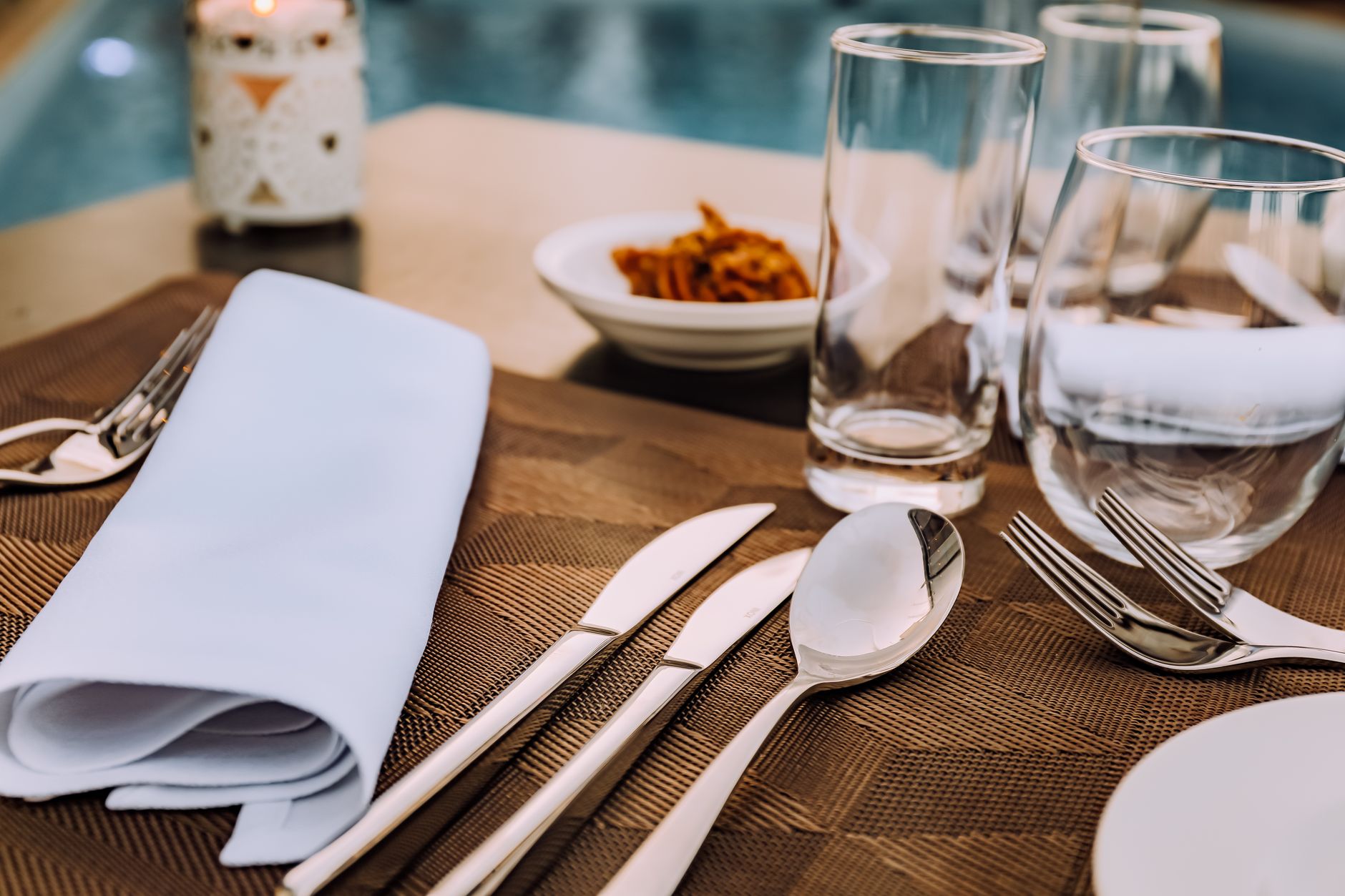
- Forks go to the left of the plate, tines up, in the order of use from outside to inside.
- Knife goes to the immediate right of the plate, blade facing inward toward the plate, which is a detail almost everyone gets backward.
- Spoons go to the right of the knife, bowl up, again outside to inside by order of use.
- The dessert spoon or fork, if used, is placed horizontally above the plate, handle pointing in the direction of the hand that will pick it up.
- The water glass sits above the tip of the knife, and any wine glass sits to the right of that, slightly forward.
- The bread plate, if used, sits above the forks, to the upper left.
The knife blade facing inward is not a decorative choice. It is a leftover safety convention from when knives at the table were sharper and more frequently used as tools, and a blade facing outward toward the next diner was considered both rude and genuinely more dangerous to reach past. It has stayed the convention because it still reads, correctly, as the more careful way to lay a blade down.
Why the fork goes tines up in some settings and down in others
American table setting places forks tines up. Continental European setting places them tines down, with the maker’s mark on the back of the fork meant to show. Neither is wrong, but mixing the two conventions at a single table setting looks inconsistent rather than intentional. Pick one convention and hold it across every place setting at the table, rather than switching fork orientation from one seat to the next.
A table setting that looks correct but was assembled without knowing why each piece sits where it does will eventually put something in the wrong place, because there is no logic underneath the arrangement to correct for it.
Napkin placement depends on what happens first
A folded napkin goes to the left of the forks, or directly on the center of the plate if the plate will not be used until food is served. If a first course is already plated when guests sit down, the napkin belongs on the plate itself, or beside it, not underneath a fork stack where it has to be pulled out and disturbs the utensils. For a buffet or an informal meal, the napkin can be rolled or wrapped around the utensils as a bundle, which is a practical shortcut, not a formal one, and reads as casual rather than careless when the meal itself is casual.
Spacing that actually matters
Each place setting needs roughly two feet of table width to avoid elbows colliding mid-meal, and the plate itself should sit about an inch from the table’s edge, not flush against it, so it does not get bumped by a knee or a chair pushed in. Glasses go slightly forward and to the right of the plate’s centerline, close enough to reach without extending the arm across the knife.
The five-minute version
Set utensils in the order they will be used, outside to inside, knife blade facing the plate, glass above the knife tip. Once you know that the arrangement is built around the sequence of the meal rather than around how it looks in a photograph, you stop needing to memorize a diagram, because the placement follows logically from what course comes first.