This article may contain affiliate links. If you buy through them, Living Beautifully Daily may earn a small commission at no extra cost to you. Learn more.
Most people own exactly one sewing needle, the one currently threaded and stuck in a pincushion, and they use it for everything from hemming linen to reattaching a button on wool coat. Then they wonder why the stitch on the coat looks strained and the stitch on the linen puckers. The needle was never suited to either job.
Hand sewing needles are grouped by type and by size, and both matter. Type determines the shape of the point and the eye. Size, confusingly, runs in reverse: a higher number means a finer, thinner needle, and a lower number means a thicker, sturdier one. A size 10 needle is fine and delicate. A size 3 needle is thick and strong. This backwards numbering trips up almost everyone the first time, and it is worth just memorizing rather than re-deriving every time you shop for needles.
Sharps, betweens, and why the point shape matters
A sharps needle has a medium length and a sharp point, and it is the closest thing to an all-purpose hand needle, suited to plain weaves like cotton and linen. A betweens needle is shorter, which sounds like a small difference but actually gives you more control for short, precise stitches, the kind used in tailoring and detailed hand finishing on wool or heavier fabric. Using a long sharps needle for tailoring work makes the stitches harder to keep small and even, because the extra length gives the needle more room to wander between your fingers.
Embroidery needles have a larger eye to accommodate thicker embroidery floss, and a slightly blunter point on some varieties so the needle separates threads rather than piercing through them, which matters on tightly woven fabric where a sharp point would distort the weave. Using an embroidery needle on plain mending work usually leaves a hole too large for the thread, which is what eventually causes a seam to loosen.
Matching needle to fabric weight
Lightweight fabric, silk, fine cotton, chiffon, needs a fine needle, something in the size 9 to 12 range, because a thick needle punches a hole larger than the thread filling it, and that gap is where puckering and visible stitch marks come from. Medium weight fabric, quilting cotton, linen, most shirting, does well with a size 7 to 9. Heavy fabric, denim, wool coating, canvas, needs a thicker needle, size 3 to 6, strong enough to push through multiple layers without bending, and with a point sturdy enough not to snap under the resistance.
A needle too fine for heavy fabric will bend or break under the pressure needed to push it through. A needle too thick for light fabric will leave visible holes and distort the weave around each stitch, which is the puckering people usually blame on their thread tension when it is actually the needle.
The stitch tells you almost immediately if the needle is wrong. A smooth pull through fabric means the match is right. Resistance or a visible hole means it is not.
Thread weight has to match too
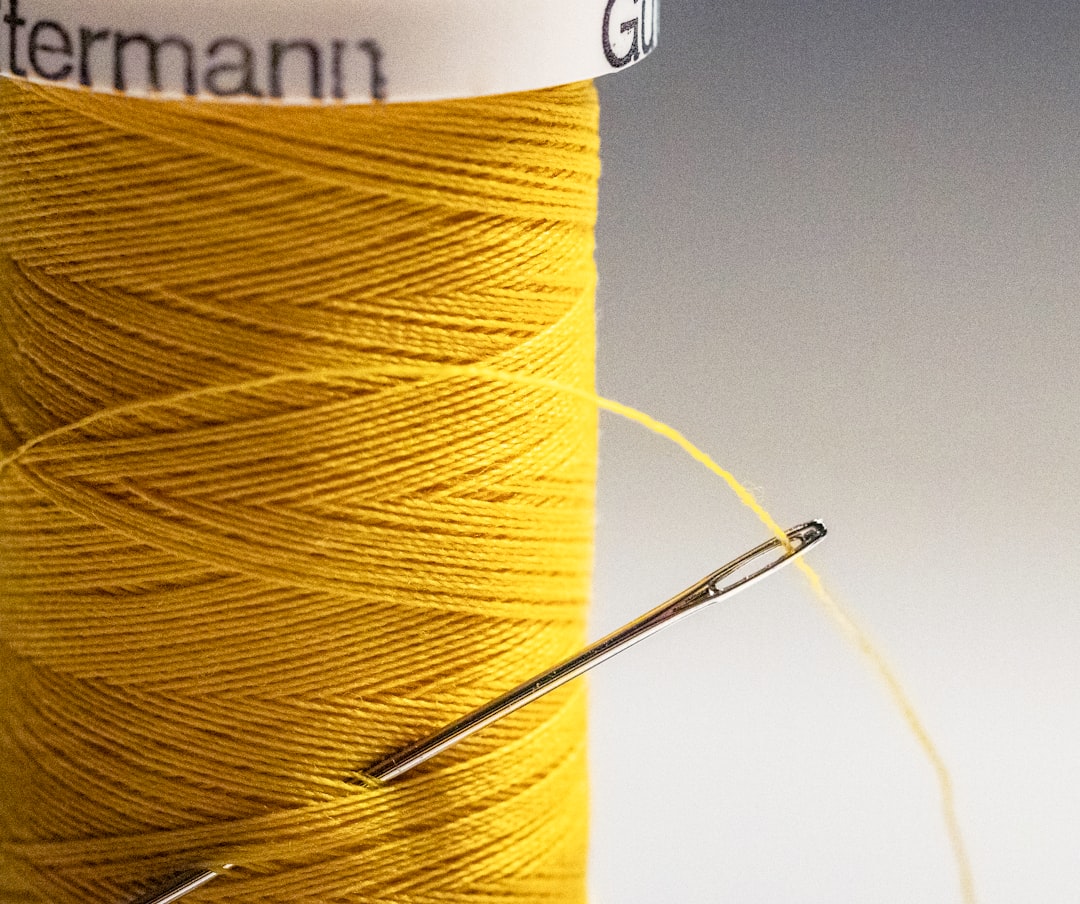
A needle is only half the equation. The eye of the needle has to accommodate the thread without the thread dragging through a hole too small for it, and without the thread being so thin that it slides loosely and knots. Heavier thread, the kind used for buttons or upholstery repair, needs a needle with a proportionally larger eye, which usually means a lower number, thicker needle regardless of the fabric weight, because the needle has to physically fit the thread through the eye without fraying it on every pass.
Reading the tip of a used needle
A needle that has been used heavily on synthetic fabric or through zippers can develop a slightly blunted or burred tip without it being visible to the eye. The way to check is to run the point lightly across the pad of your thumb. A sharp needle glides. A dulled one drags or catches faintly. This is worth checking before starting a project on fine fabric, because a dulled needle on silk or chiffon will snag the weave instead of passing cleanly through it, and once a weave is snagged there is no undoing it.
Keeping a small range instead of one needle
You do not need a full case of every size. A practical range for most home mending is a sharps needle in a light size for everyday fabric, a betweens needle for tailoring or wool, and one heavier needle for denim or canvas repairs. Three needles, chosen for what they are actually doing, will outperform a single all-purpose needle used for every job, because the needle is not a neutral tool. It is shaping the hole the thread has to live in, and that hole is either the right size or it is not.