This article may contain affiliate links. If you buy through them, Living Beautifully Daily may earn a small commission at no extra cost to you. Learn more.
I watch people sharpen knives the way they watch other people parallel park: confident, fast, and almost always wrong. The stone is not the problem. The problem is the angle, and specifically the fact that most home cooks pick a new angle every three strokes without noticing.
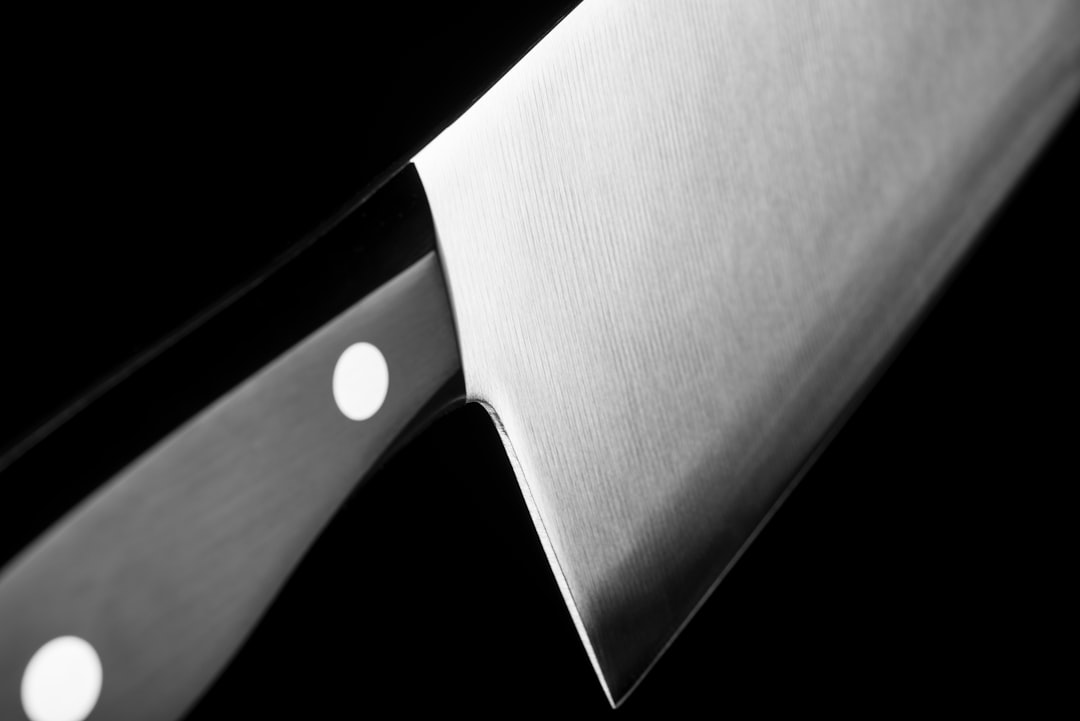
A kitchen knife is not one tool. A chef’s knife, a paring knife, and a bread knife all do different jobs, but the edge geometry that makes them cut well is governed by the same idea: the angle between the blade and the stone determines whether you are making an edge that is thin and sharp or thick and durable. Steeper angles, something like 20 to 22 degrees per side, give you a stronger edge that holds up to cutting boards, bone, and careless dishwasher trips. Shallower angles, closer to 15 degrees per side, give you a finer edge that slices cleanly through a tomato skin without pressing it flat first. Most Western kitchen knives are factory ground somewhere around 20 degrees per side. Most Japanese-style knives are closer to 15.
Why your angle keeps drifting
When you sharpen by hand on a stone, your wrist is not a hinge. It wants to rock, and every time it rocks, the angle at the heel of the blade is different from the angle at the tip. This is why a knife sharpened for ten minutes by an impatient hand often comes out with a wavy edge, sharp in the middle and dull at both ends. The fix is not more pressure or more strokes. The fix is a smaller, more deliberate motion that keeps the angle the same from heel to tip.
A trick that actually works: lay the blade flat on the stone, then lift the spine until you can just slide a nickel under it. That gap is roughly 15 degrees. Two stacked nickels gets you closer to 20. It is a crude reference, but it is far more consistent than guessing, and it gives your hand a physical memory of what the angle feels like instead of a number you have to trust blindly.
The whole blade, not just the belly
Most people sharpen the curved belly of the blade, where the motion is easy and satisfying, and neglect the heel near the handle and the last inch near the tip. Both of those sections do real work. The heel is what you use for the initial bite into a squash or a dense loaf. The tip is what you use for scoring and detail cuts. A knife that is sharp in the middle and dull at the ends will feel sharp when you test it on your thumbnail near the belly, then disappoint you the moment you try to cut through something tough at the heel.
To cover the whole edge, break the stroke into three overlapping sections: tip, belly, heel. Sharpen each section with the same number of passes at the same angle, rather than sweeping the whole blade in one long stroke and hoping the angle holds. It takes longer. It also produces an edge that behaves the same way at every point along the blade, which is the entire point.
Steel type changes the math
Softer stainless steels, common in mid-range kitchen knives, sharpen quickly but also dull quickly, so a slightly steeper angle buys you more time between sharpenings. Harder steels, the kind used in higher-carbon Japanese blades, hold a thinner edge for longer but chip more easily if you drop the angle too far or use them on bone and frozen food. Knowing roughly what steel you own changes how aggressive you should be about chasing a shallow angle. If you do not know the steel, the manufacturer’s spec sheet or the box the knife came in usually says.
A knife sharpened at the wrong angle is not ruined. It is just working harder than it needs to, and so are you.
Honing is not sharpening
The honing steel that comes with most knife sets does not remove metal or restore an edge. It realigns a microscopically bent edge back into place, which is why a few strokes on a honing steel before you cook can make a knife feel sharper without actually being sharper. Confusing this with sharpening is one of the most common mistakes in a home kitchen. If a knife still will not cut cleanly after honing, it needs stone work, not more honing.
Testing the result honestly
The paper test, slicing through a sheet of printer paper held in the air, tells you whether the edge is even sharp at all, but it does not tell you whether the angle is consistent along the blade. A better test is cutting through a ripe tomato without pressing down, moving from the heel to the tip in one motion. If the knife slides through the skin at every point along the blade without you adding pressure, the angle held. If it catches or tears in one spot, that is where your hand drifted.
Getting the angle right is less about talent and more about resisting the urge to rush. A knife sharpened slowly at a consistent angle over ten minutes will outperform one sharpened quickly at a shifting angle over twenty. The stone does not do the work. Your hand does, and it only does it well when it stops guessing.